
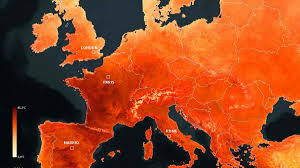
Europe Battles Record-Breaking Heatwave
An extraordinary heatwave in Europe has shattered numerous temperature records and had major impacts on human health, ecosystems, agriculture, infrastructure and labour productivity. It is accompanied by localized violent storms and in some areas by worsening drought and the risk of wildfires. Share: Related Topics WMO, its members and partners are mobilizing with early warnings and coordinated heat-health action plans to try to save lives and inform decision-making on how to minimize economic damage and disruption. Extreme heat is expected to occur at increasing frequency and intensity and duration, according to the Intergovernmental Panel on Climate Change. Europe is the world’s most rapidly warming continent. “Heatwaves like this are what we expect to see in a changing climate,” said John Kennedy, head of climate information at WMO. “In the 50 years since the historic heatwave in 1976, Europe as a whole has warmed by around two degrees. It’s the fastest warming continents and extremes of temperature have increased too,” he said. World Health Director-General Tedros Adhanom Ghebreyesus said that more than 1300 excess deaths have been recorded since 21 June linked to the extreme heat in Europe. More than 150 million people on the continent were impacted, he wrote in a post on X on 28 June. The heatwave – which moved up from the Iberian Peninsula – is expected to spread over large parts of Western, Central, and Southern Europe and the Balkans by 30 June, according to Climate Watch guidance issued by one of WMO’s regional European climate monitoring centres, which is led by the Deutscher Wetterdienst (DWD). The regional centre’s Climate Watch information is intended as guidance for National Meteorological and Hydrological Services who are responsible for issuing advisories and warnings in their own territories. Snapshot of records (starting with most recent) The WMO Secretariat is compiling a regularly updated snapshot of temperature records. This is not a fully exhaustive list and some of the figures are provisional. It is intended as a guide to help in media reporting and to provide information on the scale of the extreme heat. Germany broke new temperature records for three consecutive days, with the town of Coschen in eastern Germany near the border with Poland reporting 41.7°C on 28 June. A total 252 weather stations recorded all time temperature records – the highest ever. According to DWD, 46 stations throughout Germany recorded temperatures of above (40°C) -until 27 June. Overnight temperature records also tumbled. A weather station in East Saxony reported an overnight minimum temperature of 29.4 °C. DWD termed the heatwave as “historic.” Hungary: A new June temperature record of 40.7°C was recorded near the capital Budapest on 28 June, with heat forecast to intensify further. Poland also recorded a new all-time temperature record, provisionally of 40.5°C, as did the Czech Republic. Austria set a new June temperature record of 40.0 °C in the Vienna City, with a Red Alert continuing for the capital on 29 June, according to Geosphere Austria. The United Kingdom broke the June temperature record for three consecutive days, with 37.3 °C recorded in southern England on 25 June – a provisional figure which was likely to be revised upwards. The UK’s Met Office issued Red Warnings for Extreme Heat once again for 26 June – the first time in the history of the current weather warnings system that red warnings have been issued for three straight days. This comes just weeks after May also saw UK daily temperature records broken. In the Netherlands, the Dutch national meteorological service, KNMI, issued an unprecedented Red Alert for extreme heat for eight provinces for 26 June for 26 June, and reported a number of new station records, and a new national June temperature record of 39.4 °C. Denmark set a new all time high temperature of 37.0 °C in two locations, breaking a record set in 1975, according to the Danish Meteorological Institute. Switzerland set a new June temperature record of 39°C in the northern city of Basel, according to Meteo-Suisse.